Showing posts with label silver coins. Show all posts

Monday, 15 June 2015

Gold, Silver Prices Dip on Low Demand, Weak Global Trend!

Gold prices declined by Rs 55 to settle at Rs 27,075 per 10 grams at the bullion market on Saturday due to ease in demand from jewellers at domestic spot market coupled with weak global cues.


Silver also softened by Rs 190 to Rs 36,910 per kg on reduced offtake by industrial units and coin makers.

Traders said besides weak global trend, low demand from jewellers and retailers mainly led to the decline in prices of both the metals.

Globally, gold fell by 0.06 per cent to $1,181.30 an ounce and silver by 0.44 per cent to $15.96 an ounce in New York in yesterday's trade.

In the national capital gold of 99.9 and 99.5 per cent purity fell by Rs 55 each to Rs 27,075 and Rs 26,925 per 10 grams, respectively. Gold prices gained Rs 20 yesterday.

Sovereign also eased by Rs 100 to Rs 23,300 per piece of eight gram.

Following gold, silver ready moved down by Rs 190 each to Rs 36,910 per kg and weekly-based delivery by a similar margin to Rs 36,595 per kg.

On the other hand, silver coins continued to be traded at previous level of Rs 54,000 for buying and Rs 55,000 for selling of 100 pieces.

Story first published on: June 13, 2015 15:24 (IST)

http://profit.ndtv.com/news/commodities/article-gold-silver-prices-dip-on-low-demand-weak-global-trend-771315

Monday, 20 April 2015

Dissing The Dollar! - Downtown Kingston Wholesalers Reject $1 coins

Several wholesalers in downtown Kingston are rejecting $1 coins as payment for goods, declaring the legal tender unacceptable in their facilities.

"Go throw them weh; nobody no want them," declared one wholesale operator on East Queen Street when a member of our news attempted to pay 35 $1 coins for an item.
 
Downtown Kingston Jamaica

"I don't owe you any explanations," growled the woman of Asian descent when asked for an explanation as to why she would not accept the coins.

It was a similar story for more than half the other wholesales in the business district as they declined the dollar as payment for items valuing between $35 and $40.

One worker in a wholesaler declared that her boss had a policy that he does not take $1 coins. "No, sah. Him not taking it," the woman said while pointing to a man seeming of Asian descent.
 
Bank of Jamaica $1 Dollar Coins

He ignored The Sunday Gleaner's query as to why he does not accept $1 coins.

One person who was in the wholesaler at the time charged that the operators, who are mainly Chinese, do not want to accept the coins because "them don't want to bank them money so them no want the heavy silver (coins)".

Under the Bank of Jamaica (BOJ) Act, coins are legal tender of payment of an amount not exceeding the face value of a maximum of 50 coins in any combination of denominations.

Last week, the BOJ reiterated that "coins are a legitimate means of settling small transactions and are, by law, legal tender for payment".

According to the BOJ, it stands ready to exchange coins for notes whenever persons accumulate more coins than they deem necessary to keep for daily transactions.

"And we redeem coins for merchants and individuals on a regular basis. We will continue to inform the public as to the provisions of the law with respect to legal tender, and stand ready to facilitate the issue and redemption of notes and coins as demanded by the public," said the BOJ in response to The Sunday Gleaner queries.

However, the BOJ pointed out that not being a law enforcement agency, it is not able to compel business operators to accept the various denominations.

Thursday, 2 April 2015

Queen To Hand Out Royal Maundy Coins Tomorrow For 60th Pre-Easter Tradition!

The Queen will undertake the pre-Easter tradition of handing out commemorative Royal Maundy coins tomorrow for the 60th time since her accession to the throne.

Each year, the Royal Mint produces a limited number of special coins for the service. The one, two, three and four pence coins are all legal tender, but the specially made silver coins are not intended for everyday use.


Unlike those in general circulation, the Royal Maundy coins continue to bear the portrait of the Queen produced by Mary Gillick for the first coins of her reign.

Gillick, a sculptor, designed the portrait which appeared on the coins of the UK and some Commonwealth countries from 1953 until preparations for decimalisation began in 1968.

The portrait of the Queen wearing a wreath on her head was considered to reflect the nation's optimism as it greeted a new monarch in the post-war years.

The elderly recipients of Royal Maundy coins have been chosen for the service they have given to their parish and community.

This year the group of 89 men and 89 women from the Sheffield area will each receive two leather pouches, one white and one red, from the Queen during the Royal Maundy service at Sheffield's Church of England Cathedral.

The white purse will contain Maundy coins equating in pence to the Queen's age (89p at present), while the red purse will contain a £5 and a 50p coin.

There have been just five official UK coin portraits created during the Queen's reign, the most recent by Royal Mint designer Jody Clark.

The Royal Maundy is an ancient ceremony which has its origin in the commandment Christ gave after washing the feet of his disciples the day before Good Friday.

The Mint said it seems to have been the custom as early as the 13th century for members of the royal family to take part in Maundy ceremonies.

http://www.westerndailypress.co.uk/Queen-hand-Royal-Maundy-coins-tomorrow-60th-pre/story-26265639-detail/story.html

Friday, 13 February 2015

The Origins Of Money: Means Of Exchange!

MONEY may feel as solid as the Bank of England, but it is an ever-shifting phenomenon. People have gone from using gold or silver coins through paper notes and plastic cards to the modern practice of “quantitative easing” (QE).


To some on the Republican right in America, this evolution is a rake’s progress, in which QE is a debasement of the currency leading to hyperinflation and economic ruin. 

They want a return to the gold standard, whereby the amount of money would be linked to a country’s gold reserves. Politicians (and central bankers) would be unable to tamper with it.

But in a new book, “Making Money”, Christine Desan, a Harvard law professor, challenges the view of money’s history as a fall from grace. She is part of the “cartalist” school which argues that money did not develop spontaneously from below, but was imposed from above by the state or ruler. 

A sovereign might offer tokens as payments for goods and services, and agree to accept those tokens back to meet taxes or debts. In effect a guarantee from the state, this made such tokens useful for private trade. And governments were able to charge for the service of turning gold and (more usually) silver bullion into coin.

Despite this incentive for the creation of money, the standard medieval complaint was that there was not enough money to go round. The currency was too valuable for everyday trade; back in 13th-century England, one farthing, or a quarter-penny, bought four cups of ale (those were the days). The daily wage was a penny or two.

Modern economists tend to think of money as a real, not a nominal, issue; expanding the money supply may raise prices but not affect the volume of goods and services being traded. But Ms Desan argues that, in medieval times, this was not the case. 

The lack of coins made it difficult to trade. Coin shortages encouraged the use of money from abroad, the author argues. In addition, the coinage was debased by the medieval practice of “clipping” of coins, or shaving off the edges to save the silver. 

All this led to the frequent need to reclassify or re-denominate the coinage. Sometimes it was the monarchs who were pulling off this trick as a way of boosting their own finances. At other times re-denomination also helped to boost activity; an early version of QE.

Nevertheless, every change prompted howls of complaint from the losing parties. Re-denominations also led to tricky legal disputes. When repaying a debt, was the borrower obliged to repay a set number of coins? 

When creditors tried to argue that it should instead be a set amount of silver, the privy council of James I declared that “the king by his prerogative may make money of what matter and form he pleaseth, and establish the standard of it.”   

This attitude underwent a reversal after the Glorious Revolution, which brought William III to power in 1689 with the help of Whig financiers who set up the Bank of England. The king’s creditors naturally had an interest in sound money, and Britain adopted the gold standard, which was to last, in peacetime at least, for much of the next two centuries. 

Over the long run, prices were remarkably stable during this period; over the short run, however, the discipline required by this standard required some short, sharp slumps which imposed considerable pain on the working classes. 

The advent of universal suffrage after the first world war made it impossible for democratically elected governments to impose such costs on their voters; commodity money disappeared and “fiat” money (ie, money that is what the government declares it to be) became the norm.

In essence, history has seen a battle between money’s role as a store of value (which requires a restricted supply) and its role as a means of exchange (which can require the creation of more money). 

This battle is still going on. Ms Desan displays exemplary scholarship in detailing money’s origins, albeit in an academic style that is hard work for the general reader. But her study is worth the effort.


http://www.economist.com/news/books-and-arts/21643036-monetary-systems-have-always-been-imposed-sovereign-means-exchange

Monday, 9 February 2015

Why Is The Dollar Sign A Letter 'S'?

The letter 'S' appears nowhere in the word "dollar", yet an 'S' with a line through it ($) is unmistakably the dollar sign. But why an 'S'? Why isn't the dollar sign something like a 'D' (like the former South Vietnamese đồng, or the totally-not-a-joke-currency Dogecoin)?

There's a good story behind it, but here's a big hint: the dollar sign isn't a dollar sign.

It's a peso sign!

Bohemian Rhapsody
Though the dollar and peso symbols are inextricably linked, the origin of the word "dollar" is rooted  elsewhere. Its story begins in 1500s Bohemia, a central European kingdom spanning most of today's Czech Republic.

Central Europe had just become rich with silver. After centuries of sending its silver (and gold) abroad in trade for consumable luxuries like silk and spices (very little of which ever found its way back), new sources of silver ore were discovered in Saxony, German Tyrol and Bohemia. 

With far more silver than still-scarce gold, Tyrol began replacing its teeny-tiny gold coins with big heavy silver coins of equal value. The newly-minted guldengroschen coin, 32g of nearly-pure silver, was an instant hit.

Fast forward to 1519. The Kingdom of Bohemia's Joachimsthal region was finally producing enough silver to begin minting a heavy silver coin of its own. 

This new Bohemian joachimsthaler coin improved on the guldengroschen, adjusting the weight and purity slightly to make the coin evenly divisible into existing European weights and measures. 

It rapidly became the new European favorite, and soon most anyone with silver was minting their own version. The thaler suffix came to refer to any and all of these similar heavy silver coins . . . 

And over the next few decades the thaler coins came to have several transliterated variations on their names: the Slovenian taler, Dutch daalder, and in English, the word thaler became dollar.

Monday, 2 February 2015

Buying Silver Coins!

When it comes to silver coins they were used in the past a lot and most of the times, they were the currency that people relied on in order to buy things. There are records that these coins were existent even before Christ. But they weren't only used in order to buy food or pay taxes, they were also used in gambling.


As such, taking a look at every country in the world, each country has a certain coin that'll have a connection with the type of currency that they pertain to. Yet, if you're interested in buying such coins, then you should know that there aren't too many places out there that you can find them in.

It doesn’t really matter what silver bullion coins currency you're talking about, because it's made out of silver that's 99.9% pure. There are a lot of people that nowadays are buying such silver coins, because they believe that the next financial crisis will be soon. 

We're already dealing with one and if there will be another coming up, I’m going to kill myself. Well I'm just joking.

So, is there enough silver in this world that could keep us all safe from the ravaging effects of another financial crisis? No! Silver is in fact a precious metal and like any precious metal out there, it's really short on supplies and that's why it also has a price that reflects this. 

But still, you'll be able to buy silver coins if you want to, you only need to look for them in the right places. Talking about such pure silver coins, you should know that worldwide there are a lot of people that love collecting them. And overall, this is really a very good investment.

If you're a new collector, then you should know that the silver coins value is high and you'll always be able to recover the money you've spent for them and even more than that. There are some coins that'll have very beautiful details engraved on them, some of them even telling a great story.

When it comes to these types of coins, I'm advising you to not get them from the internet, because you'll not be able to check them out and see if they're really okay or not. You could thus be scammed really easily, which isn't a pleasant situation for you and your hard earned money.

Wednesday, 12 November 2014

How People Get Rich Investing In Silver!

Gold gets all the headlines, but silver is a shrewd investment if you know what you're doing. One method of investing in silver is the tried-and-true idea of buying low and selling high. And right now, silver has momentarily dipped to 2008 prices.

 Silver Coins

So that might be your signal to invest in silver rounds, silver ingots or silver bars. However, there's another way of investing in silver that a lot of people don't know about. If you buy U.S. coins minted before 1965, many of them are made of 90% silver!

In fact, a long-time customer at the Liberty Coin & Currency store in Vancouver told an interesting story about how a silver coin held its value. He decided in 1964 to put a brand-new quarter in his pocket and carry it around for a while. 

At that time, he said he could buy a gallon of gas with that quarter. As amazing as it sounds, he is still carrying that same quarter. And today, that same quarter is still worth about one gallon of gas because of the silver content. 

However, if he had saved a quarter minted in 1965 (with zero silver content), it would only be worth 25 cents. So, in essence, silver has kept up with inflation.

The benefit of investing in bags of 90% silver coins is that you can typically buy them at a discount to silver bars or silver bullion coins. 

You pay a modest premium on top of the spot price of silver when you buy bullion. But bags of 90% silver coins carry a smaller premium when purchased in volume. That's why many people swear by investing in bags of silver coins minted before 1965.

Liberty Coin & Currency keeps live silver prices on our home page, so it's easy to see when it might be a good time to cash in on your investment. 

If you are ever interested in investing in silver bullion or bags of 90% silver coins the experts at Liberty Coin & Currency would be happy to discuss the advantages of both. And we would love to hear any of your gold or silver stories.

Monday, 6 October 2014

Silver & Gold Searches Spark Discoveries!

FLORENCE – Brad Karoleff, the 2013 recipient of the American Numismatic Association Harry J. Forman Dealer of the Year Award, shared the history of the search for silver coins starting with Columbus sailing for the west in 1492.

Numismatic expert Brad Karoleff shares coin lore with Florence Rotary Club

Karoleff, partner with Coins Plus in Florence, spoke during the Sept. 15 luncheon meeting of the Florence Rotary Club.

Twenty years after Columbus, Cortez conquered the Aztecs by partnering with the Mexicans who were subservient to the Aztecs. The Mexicans rebelled with Cortez and took Mexico City which housed great palaces and pyramids.

The next explorer, Frances Pizarro, headed south to meet with the Incas in Peru which coincidentally was at a time when the country was in upheaval after the conclusion of a civil war. 

He conquered the Incas and took the gold for his country. In the meantime, he gives his brothers a reward land, one of which contained the mountain of Potosi which is one of the richest silver mines in the world.

The sailors headed north with their gold, passing through Panama and start heading back to Spain. The Plate Fleet head around the Florida, run into a hurricane and 12 of 13 ships sink to the bottom of the ocean.

Many other ships were successful in heading back, but English state-sponsored pirates intercepted a number of the Spanish ships. Nelson was one of these pirates who intercepted one of the largest ships in the East Indies. When he returned to England, he was given the title of Lord Admiral Nelson.

Many of these coins have been recovered and Karoleff had a few of them on display for the Rotarians to examine.

Friday, 19 September 2014

2014 Annual Uncirculated Dollar Coin Set Debut Sales!

New United States Mint figures offer opening sales for the 2014 Annual Uncirculated Dollar Coin Set. They were the highest of the week across all Mint products, not just those with silver coins.


2014 United States Mint Annual Uncirculated Dollar Coin Set

From its introduction on Monday, Sept. 8, through to Sunday, Sept. 14, collectors snapped up 12,876. The crown jewel of the set, of course, is the one-ounce 99.9% pure 2014-W Uncirculated American Silver Eagle. 

As a standalone product, the Mint charges $43.95 for it alone, but as part of the set that also has five other $1 coins, the price is $44.95. So the set is actually the better deal. To learn more about it, read this article.

To date, sales for the standalone 2014-W Uncirculated American Silver Eagle total 188,594, which includes the latest weekly increase of 628. It has been on the market since April 10.

In other product sales, the 2014 Silver Proof Set hit another milestone. The number of sets ordered by Sunday broke the 300,000 threshold when 3,906 more were purchased. Its newest total is 302,573. Sales of last year’s set ended in February at 419,719.

In the table below are the latest sales stats for collector coins and related silver products from the US Mint. Sunday, September 14, is the as of date.

Monday, 15 September 2014

Mughal-Era Silver Coins Discovered In Kanpur!

At least 61 Mughal-era coins were discovered in Kanpur in the area situated on the bank of River Ganga, as per news reports on Saturday.

                                  Mughal Era Coins From The Cantonment Area In Kanpur

The pot of coins was found by the children who were playing in the area and spotted the coins while digging.

The coins have inscription in Arabian and Persian and likely date back to the Mughal era.

As the word spread around, people rushed to the area and started looking for buried treasure.

Army and police were called and have cordoned off the area and the coins are now in their possession.

Major Chandra Prakash Badola said, “We have recovered silver coins from the spot and the area has been cordoned off.”

Friday, 5 September 2014

Rare 1681 Charles II Silver Half Crown With Mark Of The Royal African Company!

Halfcrowns, 2½ Shillings silver coins, of English King Charles II are not rare overall. Thousands survive of those minted during his reign from 1660 to 1685. 

The 1681 Halfcrown ‘in the news’ is unusual and rare in that it was minted with the symbol of an elephant (and castle) on the front (obverse) below the bust of the king. 


A relatively small number of Charles II silver coins of any denomination survive with the mark of an elephant, which relates to a semi-private company that dominated British business activities in Africa. 

This PCGS graded “AU-55”  1681 Half Crown, ‘in the news,’ will be auctioned by Heritage on Sept. 5th at the Long Beach Expo. A wide variety of other world coins, ancient coins and U.S. coins are also being auctioned this week at the same location.

The quality of this specific coin is very impressive. It is well struck and features, pleasing, mellow brown-russet natural toning with neat blue-green tints. 

Further, it scores very high in the category of originality. Although there are some noticeable defects in the prepared blank (planchet) that was used to produce this coin, there are very few contact marks and hairlines. 

Indeed, it is technically sound and was properly stored for generations. In regard to silver coins from past centuries, this piece is exceptional.

Its pedigree is extraordinary, having been in landmark collections in the past. All 17th century British coins with an elephant (or ‘elephant & castle) mark are historically important and highly demanded by collectors. 

Monday, 18 August 2014

When It Comes To Wedding Traditions, Coins Remain At The Forefront!

Will you be participating in one of the many rituals associated with wedding coins if you’re off to share in the marriage of friends or family in the near future?


When it comes to some of the many wedding traditions that are commonly observed, coins are seen as symbolic of some of the qualities associated with a happy marriage. As such, coins are prominent in ceremonies for different reasons all round the world.

UK Wedding Traditions:

Ever since the reign of Elizabeth I, coins have been associated with weddings. As time evolved, it became the custom for the bride’s parent to give the coin as a dowry gift. Then, from Victorian times onwards until the modern era, the notion that a silver sixpence is a lucky charm came into being.

Symbolising prosperity, love and unity, the giving of coins to newlyweds in these shores is linked to the rhyme: ‘Something old, something new, something borrowed, something blue, and a silver sixpence in her shoe’. Such tradition often subsequently adopted is when the father of the bride places a sixpence in the bride’s shoe wishing her prosperity, love and happiness in her marriage.

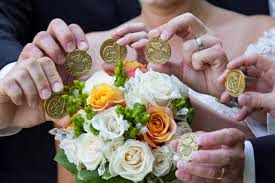
Another tradition in this country when it comes to the use of coins at weddings is when silver coins are inserted into the popped champagne or wine corks and then given to the bride and groom as one of the many mementos they can keep and cherish forever.

Less popular, yet nonetheless a superstition still sometimes practiced is that whereby a groom should give a coin to the first person he sees on his journey to the church for good luck.

Overseas Wedding Traditions:

Looking further afield, and in many countries it is common for newlyweds to receive thirteen coins representing Jesus and the twelve disciples.

Specifically in Indian ceremonies, the bride frequently scatters coins as she leaves her parents’ house to go and live with her new husband. Whilst in Sweden, before a wedding, the bride’s mother gives her a gold coin to insert in her right shoe and the bride’s father presents her with a silver coin to put in her left shoe.

Meanwhile in Poland, wedding tradition dictates that coins are tossed over the newlyweds straight after the conclusion of the ceremony itself leaving the happy couple to pick up all the coins together as a sign of their newly acquired unity.

Thursday, 14 August 2014

Silver Bar from Shipwreck Fetches Big Bucks at Auction!

In the winter of 1740, a merchant ship sank in the English Channel just miles from the coast of England. The Rooswijk fell victim to the Goodwin Sands, an area of the English Channel that is highly trafficked and is constantly changing depths with the tides.


With more than 2,000 shipwrecks in the region, it takes a lot for one to stick out. But the Rooswijk is no ordinary shipwreck.

The Rooswijk served as an important vessel for Asian and European trade. Asia had fabric and spices Europeans wanted, and the Dutch had gold and silver, which was in high demand in Asia. 

Owned by the Dutch East India Company, the Rooswijk was on its second voyage from Amsterdam to the Dutch East Indies when it went down.

Captained by Daniel Ronzieres, the Rooswijk carried two hundred passengers on its second voyage, none of whom survived. In addition to the passengers, the Rooswijk was carrying all kinds of treasure. Ten chests of silver coins—and an unknown number of silver bars and gold coins—were on board.

Though the shipwreck occurred well over two hundred years ago, that was not the end of the Rooswijk's story. Twenty years ago, an amateur diver located the shipwreck. 

The next year, a treasure hunting team began salvaging some of the treasure on board. Among the loot recovered were one thousand bars of silver and gold coins.

Last month at Schulman b.v.'s auction in Amsterdam, a silver bar from the wreck—weighing 75.45 troy ounces—was sold. Before the auction, it was estimated at $3,349. The silver bar sold for $6,201, almost $3,000 more than expected.

Friday, 8 August 2014

Numismatic Silver Coin Sales Slow, Bullion Sales Surge!

In the weekly United States Mint sales stats report, sales cooled for most silver coins and sets. Only one collector and one bullion coin were able to out-sell their previous week’s gains among silver products.


It is probably not surprising that they were the Proof Silver Eagle and bullion Silver Eagle.
Stacks of American Eagle Silver Coins

Sales of bullion Silver Eagles are the strongest in three months. One reason for general sales pull back may be attributed to the high selling activity during the previous week, and another is the typical slowness of the summer season.

This round’s best collectible silver coin seller was the 2014-W Proof Silver Eagle, which jumped by 6,063. Its prior growth was 5,893.

Following in the Silver Eagle’s shadow, the 2014 Silver Proof Set added 4,585 compared to 6,860 previously, and the 2014-Uncirculated Silver Eagle advanced by 1,166 versus 2,293 previously.

Demand for bullion American Silver Eagles soared to start of the month. After adding just 285,000 in the previous week, U.S.

Mint authorized purchasers placed orders for 1,005,000 over these last few days. This week’s sales are the strongest in three months. Year-to-date sales total 27,058,500.