Friday, 29 August 2014

The Silver Fix!

Commodity prices including that of silver are constantly in flux but one thing is certain: The cost of bread has been remarkably constant in silver terms over the last 150+ years

The old-time daily “Silver Fix” of the London Metal Exchange is gone. Established in 1897 to facilitate the exchange of metal between buyers and sellers, it had received some bad press in recent years. 
 
Hues of undue manipulations surfaced, rightly or wrongly and the old-time system finally gave way to a new electronic system of matching supply and demand.

Time will tell if the new system is any better or not. If it is sound, the new method will be applied to other commodities as well.

You may wonder though, why is the price of silver so important?


Use of Silver:
Historically the major silver use was mostly for jewelry and coinage. Artisans like silver smiths created bowls, baskets, chalices, cutlery and numerous other objects from silver. 

In medieval times many guilds were established throughout Europe (including the UK) that controlled standards of craftsmanship and material quality. Most such items were not made from pure metal but an alloy with copper containing 60-80% silver. 

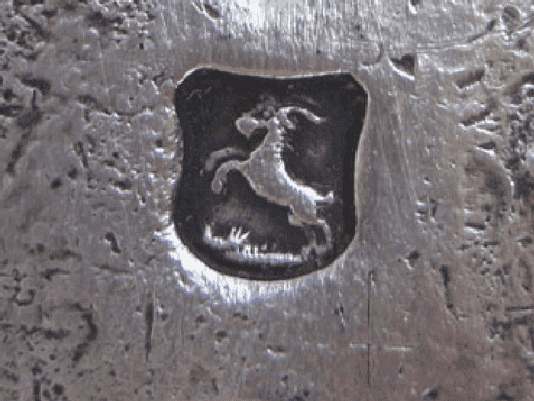
They are preserved in museums, sought after by collectors and still are common heirlooms in the western world like the basket pictured below, made from 80% silver in Germany, approximately 100 years ago.


Silver basket with 800 hall-mark, probably early 20th century

In modern times silver has found many industrial uses. The metal and its alloys have a number of unique and desirable properties such as superior electrical conductivity. That is important for electronic devices like your TV or cell phone. 

Silver also has the highest optical reflectivity and is the metal behind the glass in your mirrors. During most of the 20th century, a large portion of silver went into photographic films, a use that has declined with modern electronic cameras. 

However there are many other industrial uses for this element; even stainless steel solder is silver-based as it readily binds with that material at a relatively low temperature.

Silver amalgam, a mixture of silver and mercury is the most widely used filler for dental cavities. When the components are freshly mixed they form a paste that is easy to work with. It hardens rapidly into hard and durable fillings. 

Dental amalgam has been a major use of silver metal for many decades; some records indicate its use well over a thousand years ago in China. Silver derivatives are also used in medical applications like antiviral eye drops, wound dressings and the like.

Silver Coinage:
Coins made from silver and gold have been are around for well over two thousand years. In ancient Greece, a silver Drachma (containing 1/8 oz. of silver) was the pay for a day of common labor. In Queen Victoria’s time when the daily Silver Fix was established, 2/3 oz. of silver paid for three days of labor, not all that different from old Greece.

Prior to the mid 1900’s or so, many higher value coins were made from a high silver-content alloy as well. For example, common U.S. “silver dollars” were made from metal containing mostly silver until 1935 and up to 40% silver as late as 1974. 

Canadian common silver dollars were minted with 80% silver until 1967. Pretty much all of such coins have been collected by people realizing that the metal value now exceeds the coins’ face value. Currently an ounce of (pure) silver goes for about $20, a far cry from the face value of $1 of an old silver dollar.

The Fix:
As you can surmise, the price of silver is of importance for all consumers and users of which there are many. Like other materials produced and consumed in large amounts, the price of the metal is subject to fluctuations on the world market. 

It can rise or fall severely in mere seconds. Any problems with a major mine or other potential supply interruptions are immediately noticed by the markets with consumers or speculators buying ahead of the actual requirement and the price adjusts accordingly, up or down.

Whether you like it or not, commodity prices including that of silver are constantly in flux but one thing is certain: The cost of bread has been remarkably constant in silver terms over the last 150+ years, about one tenths of an ounce for a loaf or roughly the amount of silver in an old dime.

Wednesday, 20 August 2014

Niue “The Power Of The Pyramid” Pyramid-Shaped Gold And Silver Coins!

The Government & Treasury of Niue have launched a new set of coins which feature the extraordinary and mythical designs of ancient on a unique pyramid-shaped coin to enhance those designs. 


The technology utilized in the production of these four-sided, pyramid-shaped coins is that of a similar process used for the well-known Fortuna Redux coins produced by the Mint last year.
Niue Pyramid Shaped Coin

For thousands of years people have been aware of positive, healing properties of pyramid-shaped objects. In the interiors of such objects magnificent energy of space is concentrated. 

Several studies have suggested that a positive effect that even scale model replicas of pyramids have on their surroundings when placed in accordance to magnetic cardinal directions.

The Great Pyramids of Giza are one of the largest works of architecture made by humankind. Built for pharaohs Khufu, Khafra and Menkaure, the pyramids fascinate us with their perfect design, position and purpose resulting in thousands of years of marvel at the incredible skills and knowledge of its designers for nearly five millennia. 

Although these out-of-the-ordinary treasures of Egyptian architecture have been subjected to wind, dampness, sand storms, deconstruction and pillaging for centuries, they have remained almost intact becoming a symbol of the highly developed civilization and, an immortal symbol of pharaoh’s divinity. 


The craftsmanship evident on these coins is the result of merging the skill of designers from two far-distant epochs of contemporary and ancient times as well as those of two very different elements of artistry – one in stone, the other in precious metal. 

The coins exquisitely detail the ancient Egyptian characteristic for that period – a faithful replication of images of three great pharaohs as well as decorative motifs taken from the tomb of Queen Hetepheres and the statue of Nofret of Meidum.

The coins, which have a weight of three troy ounces of pure silver each are designed by Urszula Walerzak and produced by the Mint of Poland on behalf of the Treasury of Niue. 

Three sides of the reverse depict effigies of three great pharaohs of the fourth dynasty – Khufu, Khafra and Menkaure. The forth side shows decorative elements characteristic of the era, taken from the tomb of Queen Hetepheres (Khufu’s mother) and the statue of Nofret.

The obverse or bottom side includes the effigy of Her Majesty Queen Elizabeth II which was created by sculptor Ian Rank-Broadley and used on commemorative & circulation coins of many commonwealth countries since 1998.


On the right of the Queen’s portrait is a mint mark (m/w). Along the rim are the inscriptions “NIUE ISLAND” along with “2014” and the coin’s face value of “15 DOLLARS”. Also included in the text is the hallmark of “Ag 999” and the name of the coin’s series “THE GREAT PYRAMIDS”.

Denomination           Metal                 Weight           Dimensions       Quality       

15 Dollars            .999 silver            93.3 grams    35 / 35 / 22 mm     Proof        
15 Dollars            .999 silver            93.3 grams    35 / 35 / 22 mm    Antique      
15 Dollars         Gold plated .999     93.3 grams    35 / 35 / 22 mm       BU          
                                 silver

http://news.coinupdate.com/niue-the-power-of-the-pyramid-pyramid-shaped-gold-and-silver-coins-4437/            

Tuesday, 19 August 2014

2014 1 oz Canadian Silver Woolly Mammoth Proof Coin!

The 2014 Canadian Silver Woolly Mammoth Coin is available in proof condition and is the newest offering from the Royal Canadian Mint. 


The mint has recently created these coins as the first addition to a new series called the “Prehistoric Animal Series.” Each coin is made up of .9999 pure silver and weighs one troy ounce. Aside from the silver purity, the coins carry a legal tender value of $20 CAD.

The 2014 Canadian Silver Woolly Mammoth coins are being minted in very limited numbers and only 7,500 coins are scheduled to be released. Accompanied with a display box and COA, these coins can make for a fine addition to any coin collection. 

The obverse side of the coin features a woolly mammoth; an animal that is believed to have gone extinct around 10,000 years ago. 

The ancient animal is featured walking through a mountainous landscape. Above this scene is the coin’s minting year and face value which reads “20 DOLLARS 2014.” 

Below the animal are the coin’s silver content and purity which read “FINE SILVER 1 OZ ARGENT PUR.”

Monday, 18 August 2014

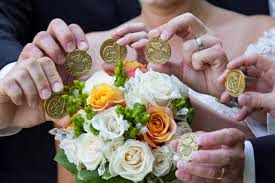
When It Comes To Wedding Traditions, Coins Remain At The Forefront!

Will you be participating in one of the many rituals associated with wedding coins if you’re off to share in the marriage of friends or family in the near future?


When it comes to some of the many wedding traditions that are commonly observed, coins are seen as symbolic of some of the qualities associated with a happy marriage. As such, coins are prominent in ceremonies for different reasons all round the world.

UK Wedding Traditions:

Ever since the reign of Elizabeth I, coins have been associated with weddings. As time evolved, it became the custom for the bride’s parent to give the coin as a dowry gift. Then, from Victorian times onwards until the modern era, the notion that a silver sixpence is a lucky charm came into being.

Symbolising prosperity, love and unity, the giving of coins to newlyweds in these shores is linked to the rhyme: ‘Something old, something new, something borrowed, something blue, and a silver sixpence in her shoe’. Such tradition often subsequently adopted is when the father of the bride places a sixpence in the bride’s shoe wishing her prosperity, love and happiness in her marriage.

Another tradition in this country when it comes to the use of coins at weddings is when silver coins are inserted into the popped champagne or wine corks and then given to the bride and groom as one of the many mementos they can keep and cherish forever.

Less popular, yet nonetheless a superstition still sometimes practiced is that whereby a groom should give a coin to the first person he sees on his journey to the church for good luck.

Overseas Wedding Traditions:

Looking further afield, and in many countries it is common for newlyweds to receive thirteen coins representing Jesus and the twelve disciples.

Specifically in Indian ceremonies, the bride frequently scatters coins as she leaves her parents’ house to go and live with her new husband. Whilst in Sweden, before a wedding, the bride’s mother gives her a gold coin to insert in her right shoe and the bride’s father presents her with a silver coin to put in her left shoe.

Meanwhile in Poland, wedding tradition dictates that coins are tossed over the newlyweds straight after the conclusion of the ceremony itself leaving the happy couple to pick up all the coins together as a sign of their newly acquired unity.

Friday, 15 August 2014

New Perth Mint Coin Releases for August 2014!

The Perth Mint is pleased to present a vast new range of products………


2014 Mother’s Love Half Ounce Silver:

The fourth release in the five coin Mother’s Love series features a reverse design of a mother brown bear and her cub; Queen Elizabeth II graces the obverse.  

The 1/2 ounce coin is being issued as a proof and struck on 99.9% pure silver planchets. Carrying a face value of fifty cents, this colorized commemorative coin is legal tender of the Pacific island nation of Tuvalu. 

The Perth Mint has set an issue limit of 4,500 examples and a maximum mintage of 6,000 pieces. Ing Ing Jong is the coin’s designer. 

The 2014 Mother’s Love Brown Bear coin has an issue price of AUS$63.50 and will be released on August 4.

Thursday, 14 August 2014

Silver Bar from Shipwreck Fetches Big Bucks at Auction!

In the winter of 1740, a merchant ship sank in the English Channel just miles from the coast of England. The Rooswijk fell victim to the Goodwin Sands, an area of the English Channel that is highly trafficked and is constantly changing depths with the tides.


With more than 2,000 shipwrecks in the region, it takes a lot for one to stick out. But the Rooswijk is no ordinary shipwreck.

The Rooswijk served as an important vessel for Asian and European trade. Asia had fabric and spices Europeans wanted, and the Dutch had gold and silver, which was in high demand in Asia. 

Owned by the Dutch East India Company, the Rooswijk was on its second voyage from Amsterdam to the Dutch East Indies when it went down.

Captained by Daniel Ronzieres, the Rooswijk carried two hundred passengers on its second voyage, none of whom survived. In addition to the passengers, the Rooswijk was carrying all kinds of treasure. Ten chests of silver coins—and an unknown number of silver bars and gold coins—were on board.

Though the shipwreck occurred well over two hundred years ago, that was not the end of the Rooswijk's story. Twenty years ago, an amateur diver located the shipwreck. 

The next year, a treasure hunting team began salvaging some of the treasure on board. Among the loot recovered were one thousand bars of silver and gold coins.

Last month at Schulman b.v.'s auction in Amsterdam, a silver bar from the wreck—weighing 75.45 troy ounces—was sold. Before the auction, it was estimated at $3,349. The silver bar sold for $6,201, almost $3,000 more than expected.

Wednesday, 13 August 2014

Silver: Investing Essentials!

Mankind has been mining silver for more than 5,000 years. It is believed to have first been mined in what is now Turkey. 

Through the centuries it became an important trading component especially along the Asian spice routes. Today, silver is not only important for the value it holds but for the vast array of usages derived from its versatility.


What is silver and why is it important?

Silver is a soft and shiny metal that has the highest electrical and thermal conductivity of all the metals, as well as being the most reflective.

Because of its physical properties silver has a range of industrial usages. It's used to make coils, solar panels, water filtrations, electrical contacts and conductors, specialize mirrors, window coatings as well as being used in photographic film and X-rays. In 2012 44% of the world's silver supplies were used in industrial application while another 5% was used for photography. 

In addition to those uses silver's natural beauty is why it is used to make jewelry, ornaments as well as high-value tableware and utensils, hence the name silverware. Jewelry making consumed 17% of the silver supply in 2012 while 4% of the silver supply was used to make silverware.

On top of that silver has value as a precious metal. As an investment it's found in coins or bullion bars as a storage of value. In 2012 nearly 9% of the silver supply was used to make coins and metals while investors scooped up 15% of supply as it was turned into physical bars to store wealth and act as an inflation hedge.

What is the history of silver?

Silver was an important metal to the ancients. Greece mined silver and used it to grow its empire. Later the Romans mined it and used to for trade. But silver really took off in 1492 when the New World was discovered as it was loaded with the precious metal. 

The Spanish found more silver in the Americas than they could have ever imagined. Between 1500 and 1800, Bolivia, Peru, and Mexico accounted for 85% of the world's silver production and trade.

Since then new silver discoveries have been made around the world along with new uses for the versatile metal. Currently Mexico leads the world in silver production as it produced 169.7 million ounces of it in 2013. It was followed by Peru, China, Australia, and Russia.

Silver's price is largely a result of supply and demand because more than half of the world's silver supplies are either for industrial uses or for other practical purposes. 

But because it is a tangible asset and recognized as a store of value its price can be affected by other factors such as inflation, currencies, interest rates, and global economic fears. This has caused its price to have notable peaks as investor demand has pushed its price higher at times of fear and inflation as noted on the following chart.


How many ways are there to invest in silver?

While buying bars of silver and having them locked in a vault is one way to invest in silver it's not the most practical investment method for the average investor. Buying items made of silver like silverware, tableware, ornaments, or jewelry, for example, are very practical purchases that also act as an investment in silver.

In addition to that buying silver coins is another way to invest in silver in small doses. In Canada, for example, the Silver Maple Leaf coin is legal tender, while in Utah silver is also legal tender and can be used to pay debts.

Silver coin. Flickr user Sprott Money

In addition to that investors can buy Exchange Traded Funds that are invested in physical silver. This saves an investor from the inconvenience of storing physical silver bars as well as providing them with daily liquidity to easily sell their silver holdings when the need arises. 

Silver exchange-traded funds have become popular with investors because of the ease of buying and selling.

Finally, investors can also invest in the stocks of silver mining companies. These companies typically mine silver and other metals like gold, copper, and zinc so there is some added diversification. But there is also added risk as these companies might not trade lock step with the price of silver as miss management or higher costs could impact the investment.

Why invest in silver?

In some ways silver is seen as an alternative to investing in gold because both store value. In fact, since the Roman times the price ratio between silver and gold has been closely watched to determine which investment is a better value. 

Because of this the same factors that drive investors into gold -- namely concerns about inflation -- also drive investors to silver. But because of its industrial value silver's price is affected by economic expansion, which is why the case can be made that it's a better hedge against inflation during times of expansion because of the increased demand for silver from industrial users.

Whether as a hedge against inflation or to profit from an economic recovery silver holds a lot of value for investors. But the combination of silver's industrial value with its value as an inflation hedge still creates a lot of volatility within the price of silver, especially in today's fast paced exchange-traded funds marketplace. 

That's why in many ways one of the best ways to invest in silver is to simply enjoy its beauty through practical long-term investments like jewelry, which is an investment that loved ones can treasure for years to come.